
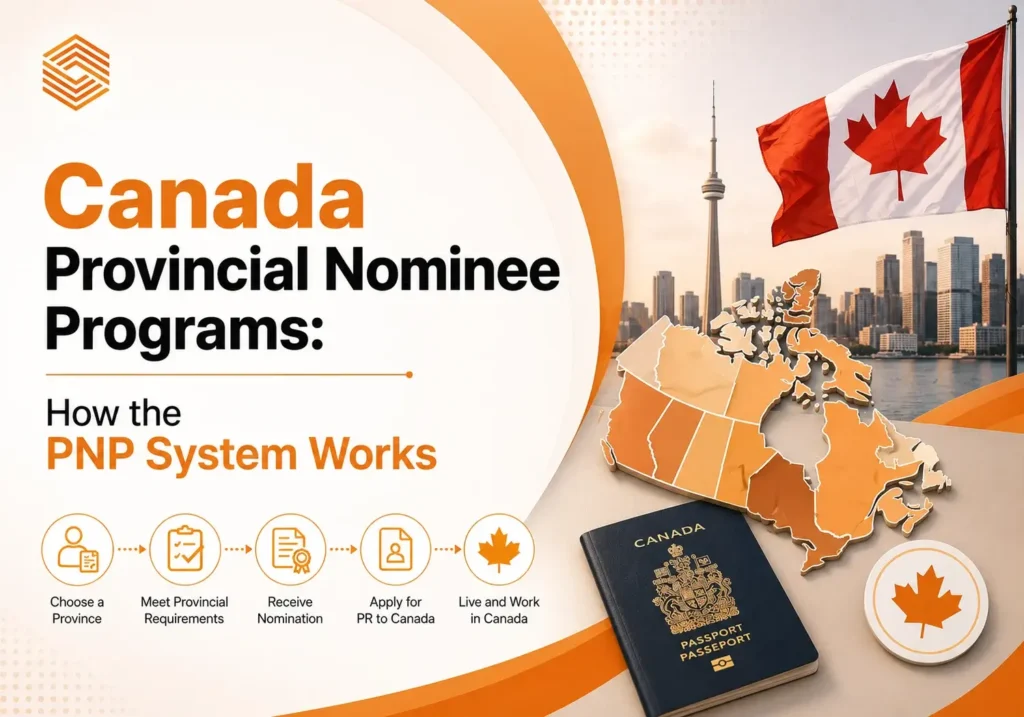
Canada Provincial Nominee Programs give skilled workers, recent graduates, and entrepreneurs a clear path to permanent residency (PR). Instead of relying only on a single federal point system, individual Canadian provinces pick candidate profiles based on local job markets and regional needs. Understanding how Canada Provincial Nominee Programs operate helps you boost your points score, secure an official nomination, and land your PR visa faster.
What is the Canada Provincial Nominee Program (PNP)?
The Canada Provincial Nominee Program (PNP) allows 11 Canadian provinces and territories to pick foreign workers and graduates for Permanent Residency (PR). The system offers two main pathways: Express Entry-aligned (Enhanced) and Non-Express Entry (Base). Getting a provincial nomination adds 600 extra points to your Express Entry score, ensuring you get an invitation to apply for permanent residence from federal immigration authorities (IRCC).
How the PNP System Works: Express Entry vs. Non-Express Entry
Canada runs its nominee programs through two main setups shared between provincial governments and federal immigration authorities (IRCC).
┌──────────────────────────────────────────┐
│ Canada Provincial Nominee Programs │
└────────────────────┬─────────────────────┘
│
┌──────────────────────────┴──────────────────────────┐
▼ ▼
┌───────────────────────────┐ ┌───────────────────────────┐
│ Express Entry Streams │ │ Non-Express Entry Streams │
│ (Enhanced) │ │ (Base) │
└─────────────┬─────────────┘ └─────────────┬─────────────┘
│ │
┌──────────────┴──────────────┐ ┌──────────────┴──────────────┐
▼ ▼ ▼ ▼
+600 Bonus Points Processing Time: Direct Application Processing Time:
to Points Profile ~7–8 Months to Province ~13–18 Months
1. Express Entry Streams (Enhanced)
These streams link directly to Canada’s main online points system.
- How It Works: You set up an online profile under the Federal Skilled Worker or Canadian Experience Class stream. Participating provinces check the candidate pool and issue direct invites.
- The 600-Point Boost: Accepting a nomination adds 600 points to your candidate profile score. This guarantees an invitation to apply for permanent residency in the next federal selection round.
- Average Wait Time: 7 to 8 months.
2. Non-Express Entry Streams (Base)
These streams run outside the central points pool and focus on specific trades, entry-level roles, or business investments.
- How It Works: You apply directly to the province through their local application system. Once approved, you get a nomination certificate and submit your paper or web application straight to federal immigration.
- Best For: Workers without high language scores, specialized trade workers, or small business owners.
- Average Wait Time: 13 to 18 months.
2026 Target Allocation & Overview by Province
Each province runs its own streams based on local job openings and population growth goals. Quebec runs its own distinct immigration system, and Nunavut does not use a PNP setup.
| Province / Territory | Program Name | Top In-Demand Fields | Annual Quota Estimates |
| Ontario | OINP | Tech, Healthcare, Skilled Trades, Foreign Workers | ~21,500 |
| British Columbia | BCPNP | Tech Roles, Healthcare, Early Childhood Educators | ~11,000 |
| Alberta | AAIP | Tech Pathways, Rural Renewal, Skilled Trades | ~10,250 |
| Saskatchewan | SINP | In-Demand Occupations, Express Entry Streams | ~8,500 |
| Manitoba | MPNP | In-Province Skilled Workers, Overseas Skilled Workers | ~9,500 |
| Nova Scotia | NSNP | Healthcare Workers, Skilled Labor Priorities | ~5,000 |
| New Brunswick | NBPNP | Skilled Trades, French-Speaking Applicants | ~5,500 |
| Prince Edward Island | PEI PNP | Healthcare, Construction, Tourism | ~2,100 |
| Newfoundland & Labrador | NLPNP | Priority Technical Skills, Health Professionals | ~3,050 |
| Yukon & NWT | YNP / NT PNP | Local Employer-Driven Streams | ~1,200 |
Step-by-Step Application Guide
Step 1: Check Qualifications & Set Up Your Profile
Get your degree or diploma verified through an official credential check (like WES). Take your language tests (IELTS or CELPIP for English; TEF or TCF for French). Create your central Express Entry profile to set your base points score.
Step 2: Pick Your Target Province
Match your work history and job code (NOC TEER classification) with active job shortage lists in each province.
Step 3: Register Your Interest
Sign up on the specific province’s portal to show you want to settle there. Provinces rank candidates using their own scoring systems based on age, work history, language scores, and local ties.
Step 4: Receive Your Nomination
When selected, the province sends you a nomination invite. You usually have 30 to 60 days to turn in your complete work records, bank statements, and personal identity documents.
Step 5: Get Final Permanent Residence Approval
Accepting the nomination gives you 600 extra points (Express Entry) or lets you submit a direct PR application (Base stream). Pass your medical check, police checks, and fingerprinting to receive your final confirmation of PR.
Get best immigration consultancy service in Dubai
Key Advantages for Candidates in the UAE & GCC
If you are applying from Dubai, Abu Dhabi, or across the Gulf region, PNP pathways offer practical benefits:
- Lower Points Requirements: General federal selection rounds often require very high points cut-offs. A PNP nomination clears that bar by adding 600 points instantly.
- Matching Regional Tech Skills: Fast-growing IT, finance, and engineering skills common in UAE job markets match high-demand tech draws in Ontario and Alberta.
- Bilingual Advantages: Applicants living in the GCC who speak both French and English can access targeted pathways in New Brunswick and Ontario.
Real-World Rules Most Guides Miss
- Proof of Settlement Savings: Applicants applying without an approved Canadian job offer must show liquid bank funds matching federal minimums. Bank statements must show clear paper trails for transferred funds over a 6-month period.
- Showing Local Intent: Permanent residents can move freely across Canada once landed. However, during the application phase, you must show clear plans to live in the nominating province (such as job applications or housing searches). Failing to show true intent can lead to cancelled nominations.
Frequently Asked Questions (FAQ)
1. Which Canadian province is easiest for foreign applicants?
It depends on your work experience and language scores. Saskatchewan (SINP) and Nova Scotia (NSNP) are popular choices because they run streams that do not require an active Canadian job offer if your line of work is listed as in-demand.
2. Can I apply for a PNP without a job offer?
Yes. Multiple options do not require a Canadian job offer. Top examples include the Saskatchewan Occupations In-Demand stream, Ontario Human Capital Priorities stream, and select targeted draws in Alberta.
3. How much does a PNP application cost?
Provincial processing fees range from CAD 0 (Newfoundland and Labrador) up to CAD 1,500 (Ontario). On top of provincial fees, federal PR processing fees (CAD 1,525 per adult, including the right of permanent residence fee) apply.
4. What happens right after I get nominated?
For Express Entry streams, the nomination appears in your online account. Once you click accept, 600 points auto-populate into your score, guaranteeing an invitation for PR during the next draw.